

Think of a scope of work statement as the ultimate game plan for your project. It’s where you clearly spell out the deliverables, timelines, payment milestones, and boundaries of your collaboration, creating a rock-solid agreement that gets everyone on the same page before a single piece of content is created.
Why a Solid SOW Is Your Best Defense in Brand Deals

If you’re a creator, you know the story. A dream brand deal starts with an exciting DM, moves to a few friendly emails, and somehow devolves into a chaotic mess of endless “just one more thing” requests. This is exactly why learning how to write a scope of work (SOW) is one of the most valuable business skills you can develop.
An SOW isn’t just paperwork; it’s your professional shield. It takes those vague conversations and turns them into a clear, concrete plan that protects your time, your creative energy, and your bank account. Think of it as the official rulebook for the collaboration, setting the ground rules before the game even begins.
Setting Clear Expectations from Day One
The whole point of an SOW is to get rid of assumptions. Without one, you’re operating on what you think the brand wants, and they’re operating on what they think you’ll deliver. That gap is where scope creep, missed deadlines, and payment headaches are born.
A well-written SOW shuts that down by defining every moving part of the partnership. For a creator, that means getting super specific about:
- The exact content you’ll produce: Forget “a few posts.” Get precise. We’re talking “two 60-second TikTok videos and three Instagram Stories.”
- The precise timeline for delivery: Lock in the dates for drafts, revisions, and the final go-live day to keep everything moving forward.
- The specific payment terms: Break down exactly when and how you’ll get paid, tying each payment to a completed milestone.
- The boundaries of the project: Clearly state what’s not included. This could be extra revision rounds or content usage rights beyond the initial campaign.
A strong Scope of Work isn’t about creating red tape; it’s about establishing professional respect. It signals to brands that you’re an organized partner who values clarity, and that encourages them to treat you like one.
From Ambiguous Requests to Actionable Plans
Imagine a brand emails you asking for a “quick revision.” Without an SOW, that could mean anything from fixing a typo to a complete reshoot. But with an SOW that specifies “one round of minor textual revisions,” that vague request is instantly clarified. If their feedback goes beyond that, you have a documented agreement to point back to.
This structure doesn’t cause friction—it prevents it. It gives both of you a neutral, agreed-upon document to guide the conversation when expectations don’t quite line up. It turns what could be an awkward negotiation into a simple business discussion based on the terms you both signed off on.
Ultimately, a killer SOW is the foundation of any healthy, professional partnership between a creator and a brand. It ensures you’re paid fairly for every ounce of work you do and protects your creative process from the chaos of fuzzy expectations. Before we get into the nitty-gritty of writing one, internalizing this “why” is the most important first step.
Breaking Down the Anatomy of a Creator SOW

Think of your Scope of Work as the official playbook for your brand collaboration. It’s where you take a great creative idea and break it down into tangible, manageable parts. Without one, you’re essentially building a project on hope and assumptions—a risky move when your reputation and paycheck are on the line.
This isn’t about drafting a stuffy legal document. It’s about creating a clear, repeatable framework that guarantees you and the brand are picturing the exact same final product. Let’s walk through the essential pieces every creator’s SOW needs.
Start with the Project Objectives
Before you even think about deliverables, you have to nail down the “why.” What does the brand actually want to achieve with this campaign? Your SOW should always kick off with a short, punchy summary of the project’s goals. This one section gives context to everything that follows.
Is the brand trying to drive sign-ups for a new app, get eyeballs on a product launch, or change perceptions among a new audience? Knowing this ensures your creative genius is pointed in the right direction.
For example, a vague goal like “promote our new skincare line” is a recipe for confusion. A strong objective gets specific: “To generate awareness and drive first-time sales for the new ‘Glow’ serum by reaching women aged 25-40 on Instagram and TikTok.”
Define the Exact Deliverables
This is the absolute core of your SOW. It’s where ambiguity goes to die. “Deliverables” is just the industry term for the specific content you promise to create. This section needs to be almost painfully detailed, leaving zero room for interpretation.
Never just write “Instagram post.” Get granular.
- Platform: Be explicit. Is it for Instagram, TikTok, YouTube, or all three?
- Format: Spell it out. An Instagram Reel is not a Carousel Post. A YouTube Short is not a 15-minute deep dive.
- Quantity: Always include a number. “Two (2) Instagram Reels” is airtight. “Some reels” is a problem waiting to happen.
- Technical Specs: Don’t forget the details. Mention video length (“45-60 seconds”), aspect ratio (9:16 for vertical), or other must-haves like “creator must use the brand’s provided audio track.”
Here’s the difference:
A weak deliverable: “One video for social media.”
A strong deliverable: “One (1) 45-second TikTok video filmed in 9:16 vertical format, featuring the ‘Glow’ serum within the first 3 seconds. The video will include on-screen text captions and use a brand-approved trending audio.”
Map Out the Project Timeline and Milestones
A timeline turns your to-do list into a professional action plan. This is where you lay out all the key dates and deadlines for both you and the brand. Breaking the project into milestones makes everything feel less overwhelming and creates clear checkpoints for progress.
This schedule also holds everyone accountable. If a brand is two weeks late shipping you the product, the SOW clearly shows how that pushes back your final delivery date.
A typical project timeline might look something like this:
- Contract Signed & Kickoff Call: June 1
- Product & Final Brief from Brand: Due by June 5
- Creator Submits Concepts/Storyboards: Due by June 12
- Brand Feedback on Concepts: Due by June 15
- Creator Submits First Drafts: Due by June 25
- Brand Provides Final Revisions: Due by June 28
- Creator Delivers Final Content: Due by July 1
- Scheduled Go-Live Date: July 5
This level of detail prevents those frantic, late-night emails and keeps the collaboration moving smoothly.
Before we get to payments, let’s pull these core sections together into a quick-reference table. Think of this as your cheat sheet for building a rock-solid SOW every single time.
Essential SOW Sections for Creator Brand Deals
| SOW Section | What to Include | Why It Matters |
|---|---|---|
| Project Objectives | A 1-2 sentence summary of the campaign’s main goal (e.g., drive awareness, increase sales, promote an event). | Aligns your creative work with the brand’s business needs and prevents mismatched expectations. |
| Deliverables | A detailed list of all content: quantity, platform, format, length, and any technical specifications. | Leaves no room for misinterpretation about what you are being paid to create. This is your biggest protection against scope creep. |
| Timeline & Milestones | Key dates for every stage: kickoff, concept submission, drafts, feedback rounds, final delivery, and go-live date. | Creates a clear, actionable plan and holds both you and the brand accountable for deadlines. |
| Usage Rights & Exclusivity | Where the brand can use your content, for how long, and if you can work with competitors during the campaign. | Defines who owns the content and how it can be used, protecting you from having your work used in ways you didn’t agree to. |
| Reporting & Analytics | What metrics you’ll provide (e.g., views, engagement rate, clicks) and when you’ll deliver the report. | Shows your professionalism and helps the brand measure the campaign’s success. |
| Payment Terms | The total fee, payment schedule (e.g., 50% upfront, 50% on completion), and payment methods. | Guarantees you get paid on time and helps you manage your cash flow. |
Having these six sections clearly defined is non-negotiable. It’s the foundation of a professional partnership that protects you and sets the stage for a successful campaign.
Clarify Reporting and Analytics
So, how will everyone know if the campaign was a success? The reporting section outlines exactly what metrics you’ll track and share with the brand after your content goes live. This isn’t just a nice-to-have; it proves your value and helps the brand calculate their return on investment.
Be upfront about what you can provide and when. Common metrics include:
- Reach and Impressions
- Views and Engagement Rate (likes, comments, shares, saves)
- Clicks (if using a UTM or trackable link)
- Story Views and Sticker Taps (for Instagram/Facebook Stories)
Always specify the reporting window. For example: “A final performance report will be delivered via email 7 days after the last piece of content goes live.”
Structure the Payment Terms and Schedule
And now, the part that keeps the lights on. This section needs to clearly state the total project fee and the payment schedule. While “Net 30” is a common term, tying payments to milestones is a much better way to manage your cash flow.
A creator-friendly payment structure often looks like this:
- 50% of the total fee is due upon signing the SOW, before any work begins.
- 50% of the total fee is due upon delivery of the final content files, before the go-live date.
This isn’t just good business—it’s essential for your financial health. The global Statement of Work (SOW) Management market has swelled to USD 2.13 billion precisely because clear terms are vital in the freelance economy. In fact, research shows that influencers who use detailed SOWs close payments 22% faster. You can explore more findings on how SOWs impact the market and see how they drastically reduce misunderstandings.
How to Define Boundaries and Prevent Scope Creep

We’ve all been there. That dreaded “Could you just…” email lands in your inbox, and suddenly you’re doing unpaid work, drowning in revisions, and feeling completely burnt out. This phenomenon, known as scope creep, is the silent killer of profitability and passion for creators.
Building a protective wall around your agreed-upon work isn’t about being difficult; it’s about being a professional who values their time and talent. Your best defense? A crystal-clear distinction between what’s “in-scope” and what’s “out-of-scope.” This isn’t just a list—it’s the strategic boundary that manages expectations from day one.
The Power of In-Scope vs. Out-of-Scope
Think of this part of your SOW as the official “rules of the game.” By spelling out precisely what you will do and, just as importantly, what you won’t do, you eliminate those murky gray areas that often lead to extra requests. It’s your first and best line of defense.
The data backs this up. Project managers who meticulously define these boundaries see 28% fewer change requests. Considering that a staggering 42% of projects fail because of poorly defined scope, getting this right is non-negotiable. Plus, this level of precision can slash potential legal headaches by an estimated 35%. If you want to dive deeper, there’s great information on how to write an effective scope of work and its impact on project success.
Let’s break it down with a real-world creator scenario.
Project: A sponsored Instagram Reel for a new coffee brand.
- In-Scope:
- One (1) 60-second Instagram Reel featuring the product.
- Inclusion of the brand’s key message: “The perfect morning boost.”
- One round of minor revisions, limited to video captions and on-screen text.
- Content delivered in the creator’s signature editing style.
- Out-of-Scope:
- Reshooting footage if the brand changes its creative direction post-shoot.
- Providing raw, unedited video files.
- Creating extra assets (like Instagram Stories or a Carousel post) from the Reel footage.
- Community management (responding to comments) for more than 24 hours after posting.
See how specific that is? There’s no room for interpretation. When the brand inevitably asks for the raw footage, you can politely point to the SOW and explain that it falls outside the original agreement.
A well-defined “Out-of-Scope” list is just as important as your deliverables. It proactively shuts down the most common avenues for scope creep and establishes you as a professional from the start.
Turning Unexpected Requests into New Revenue
So, what happens when a brand asks for something extra that you’re actually willing to do? This is where a Change Order Process turns a potential headache into a new business opportunity.
A Change Order Process is a simple clause in your SOW that outlines exactly how to handle work that falls outside the initial agreement. It formalizes the conversation and ensures you get paid fairly for any additional time, effort, or usage rights.
You don’t need a complex legal document. A simple three-step statement in your SOW will do the trick:
- Request in Writing: All requests for work outside the defined scope must be submitted via email.
- Quote and Timeline: Upon receiving the request, I will provide a separate quote and an adjusted timeline for the additional work within two business days.
- Written Approval: Work on the additional request will only begin after you provide written approval (email is fine!) of the new quote and timeline.
This simple framework completely changes the dynamic of what could be an awkward conversation.
Putting It Into Practice
Let’s go back to our coffee brand example. The client loves the Reel and now wants to use a 15-second clip from it in a paid Facebook ad. Your original SOW didn’t cover paid media usage rights.
- Without a Change Order Process: You’re in a tough spot. You either say no and potentially damage the relationship, or you say yes and give away valuable rights for free.
- With a Change Order Process: You have a clear, professional path forward. You can respond with confidence: “I’m thrilled you love the content! Using it for paid ads is outside our original scope, but I’d be happy to make that happen. As per our SOW, I’ll send over a quote for the ad usage rights by tomorrow. Once that’s approved, you’ll be all set.”
Just like that, you’ve protected your work, reinforced your value, and opened up a new revenue stream. This is how you manage scope like a pro, making sure every collaboration is a win-win.
Crafting Crystal-Clear Deliverables and Timelines
“One social media post.”
That simple phrase is a landmine. You might be thinking of a quick, authentic piece-to-camera, but the brand could be envisioning a full-blown cinematic production. This gap between expectation and reality is where so many creator partnerships fall apart. To get this right, you have to define exactly what you’re making with undeniable clarity.
It sounds a bit corporate, but one of the best tools for this is a Work Breakdown Structure (WBS). Don’t let the name fool you. It’s just a fancy way of saying you’re going to break a big, scary deliverable into small, manageable pieces. This not only shows the client your process but also helps you create a realistic roadmap for yourself.
Deconstructing Your Creative Work
Let’s use a sponsored YouTube video as an example. On paper, it’s a single deliverable. But you and I know it’s so much more than that. It’s a whole collection of different tasks, each demanding its own slice of time and creative energy.
Applying a WBS here means listing out every single step it takes to get from a blank page to a published video. It turns a vague idea into a concrete plan.
For that sponsored YouTube video, your breakdown could look something like this:
- Phase 1: Concept & Scripting
- Initial concept development and submission
- Scriptwriting (first draft)
- Brand review and feedback on the script
- Script revisions and final approval
- Phase 2: Production
- Filming all necessary footage (A-roll and B-roll)
- Recording voiceover audio
- Phase 3: Post-Production
- Editing the first cut of the video
- Color grading and sound mixing
- Creating on-screen graphics and titles
- Designing the video thumbnail
- Phase 4: Approval & Publishing
- Submitting the first video draft for brand review
- Implementing one round of minor edits
- Delivering the final video file
- Uploading and scheduling the video on YouTube
See what happened? “One YouTube video” just transformed into a detailed, multi-step project with clear stages. This level of detail isn’t about being difficult; it’s about being professional. It shows the brand you know what you’re doing and gives them confidence in your process.
Setting Realistic Milestones and Timelines
Once you’ve broken down all the work, building a timeline that actually works becomes so much easier. A good timeline isn’t just a single “due date.” It’s a series of milestones that mark the completion of each key phase from your WBS, building momentum and keeping everyone in the loop.
Even more importantly, this process shines a light on dependencies—those crucial tasks that hinge on someone else’s action. You can’t start filming until the brand ships the product, right? A well-built timeline makes these dependencies impossible to ignore.
Your timeline isn’t just for your deadlines; it’s for the brand’s, too. When a client sees “Product Samples Due by Day 3” listed in the schedule, it suddenly becomes a priority for them, not just a casual to-do item.
Let’s walk through how this looks in a real-world scenario.
Example Timeline for a Multi-Platform Campaign
Imagine a brand hires you for one sponsored Instagram Reel and three supporting Instagram Stories. Here’s a smart way to structure that timeline in your scope of work.
| Milestone | Key Tasks | Due Date | Who is Responsible? |
|---|---|---|---|
| Project Kickoff | Sign SOW & pay initial invoice | Day 1 | Brand |
| Product Delivery | Brand to provide product samples | Day 3 | Brand |
| Concept Approval | Creator submits Reel concept & Storyboard | Day 7 | Creator |
| Feedback on Concept | Brand provides feedback or approval | Day 10 | Brand |
| First Draft Delivery | Creator submits first draft of Reel & Stories | Day 16 | Creator |
| Revision Feedback | Brand provides one round of consolidated feedback | Day 19 | Brand |
| Final Delivery | Creator delivers final, approved assets | Day 22 | Creator |
| Content Go-Live | Creator publishes all content to Instagram | Day 25 | Creator |
| Final Payment | Brand submits final payment | Day 28 | Brand |
This simple table is incredibly powerful. It clearly maps out the back-and-forth of a creative partnership, puts firm deadlines on the brand for giving feedback, and links your payments directly to project progress. No more projects getting stuck in limbo because you’re waiting on an email.
When you define your work with this level of detail, you shift from being a gig worker to a strategic partner. You’re not just making a post; you’re managing a project from start to finish. This is the foundation for a scope of work that prevents headaches and ensures every collaboration runs smoothly.
Negotiating Your SOW and Avoiding Common Red Flags
You’ve done the hard work of building a detailed, professional SOW. Now for the tricky part: presenting it to the brand. Many creators see this as the final, take-it-or-leave-it step, but that’s a mistake. Think of your SOW as the start of a critical conversation, not the end of one.
An SOW isn’t just a list of demands. It’s a tool for getting on the same page and setting everyone up for a win. When you send it over, frame it as a way to make sure you’re both perfectly aligned on the project’s goals, what you’ll be creating, and when it’ll be done. This small shift in mindset turns a tense negotiation into a strategic planning session.
Presenting Your SOW With Confidence
How you bring up the SOW can make all the difference. Don’t just attach it to an email with a note that says, “Here’s the SOW.” That’s passive. You need to lead the conversation.
Try a more proactive approach: “To make sure this campaign is a huge success, I’ve put together a clear outline of the project. It covers all the deliverables, key dates, and usage rights we talked about. Can you take a look and let me know if this captures our conversation correctly?”
That kind of language shows you’re an organized, professional partner, not just someone waiting for instructions. It builds trust right from the start.
A scope of work is more than a contract; it’s a conversation starter. Its purpose is to get both parties asking the right questions before the work begins, not after a problem arises.
When a brand pushes back—and they probably will—don’t panic. The usual suspects are usage rights, payment schedules, and revision limits. These aren’t conflicts; they’re simply points to be discussed. Your job is to find a middle ground where both you and the client feel good about the arrangement.
It helps to show them the different stages of work involved. A single “video” isn’t just one task.
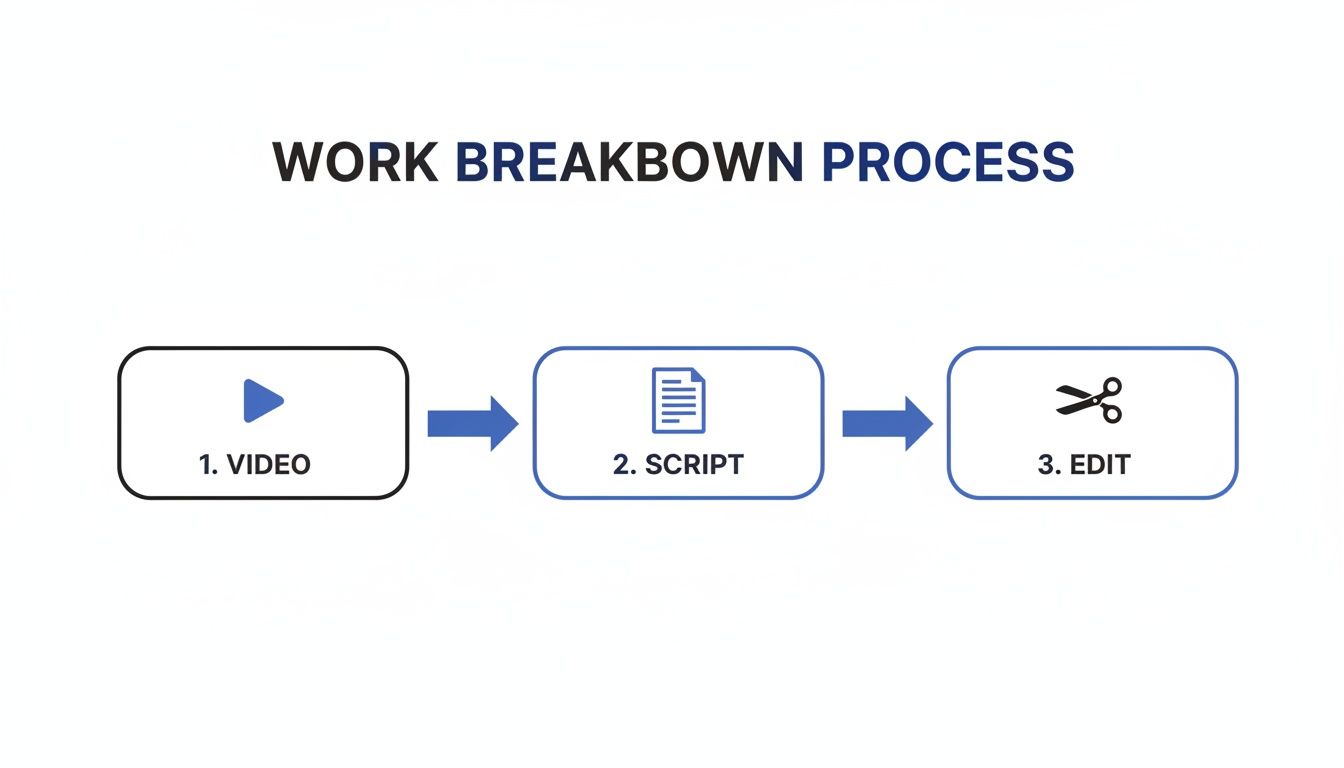
Breaking down a project like this during a negotiation makes it clear why your timelines and fees are what they are. It visualizes that “video” includes distinct phases like scripting and editing—each with its own time and resource costs that need to be accounted for.
Spotting Red Flags Before You Sign
Most negotiations are just part of the process, but sometimes, a brand’s behavior is a clear warning sign. Learning to spot these red flags early will save you from partnerships that are doomed from the start.
Keep an eye out for these tell-tale signs:
- They won’t sign an SOW. If a brand insists on “keeping things casual,” what they often mean is, “We want the freedom to change our minds whenever we want without consequence.” A refusal to put things in writing is a massive red flag.
- The language is vague and subjective. Watch out for slippery terms like “unlimited revisions” or goals defined as “brand satisfaction.” These are impossible to nail down and set you up for endless, unpaid work.
- They rush your timeline. If a brand dismisses your proposed timeline without any real discussion or demands an unrealistic deadline, it shows they don’t respect your creative process. Good work takes time.
- They’re cagey about payment. A client who balks at a 50% upfront deposit or tries to push you into “Net 60” or “Net 90” terms might have cash flow problems. This puts your payment at risk.
If a client has an issue with a reasonable term, like payment upon delivery, try offering a compromise. For instance, if they can’t do 50% upfront, maybe you can propose a three-part payment: 33% on signing, 33% on the first draft, and 34% on final delivery. This shows you’re flexible while still protecting your time.
Ultimately, your SOW is your best client-vetting tool. A great partner will see the value in its clarity. A difficult one will fight you on it. Learning to tell the difference is one of the most important skills you can build as a creator.
Common Questions About Creator Scope of Work
Even with a perfect plan, you’re going to have questions once you start putting a scope of work into practice. Let’s walk through some of the most common curveballs I see creators face when dealing with brands, so you can handle them like a pro.
What Is the Difference Between a Scope of Work and a Contract?
It’s easy to mix these two up, but they play very different roles.
Think of the Scope of Work (SOW) as the project’s playbook. It’s all about the what, when, and how—the specific deliverables, the deadlines you’re hitting, and the exact tasks you’ll be doing. This is the document you’ll have open day-to-day.
A contract, on the other hand, is the big-picture legal agreement. The SOW is usually attached to it. The contract handles the heavy stuff like confidentiality, liability, and what happens if someone needs to end the partnership. While both are important, your SOW is your daily guide to getting the work done right.
Can I Use a Template for My Scope of Work?
Absolutely. In fact, you probably should. Starting with a template is a smart move because it acts as a safety net, making sure you don’t accidentally leave out something critical like usage rights or payment terms. It gives your SOW a professional structure right from the get-go.
But—and this is a big but—never just fill in the blanks and send it off. You have to customize your template for every single project. Each brand collaboration is different. The deliverables, goals, and timelines will always be unique. Sending a generic SOW is just as bad as having none at all, because it won’t actually match what you and the brand agreed to.
Think of a template as your starting ingredients, not the finished meal. The real magic happens when you tailor it to perfectly capture the details of the collaboration.
This simple step ensures your SOW is a genuine reflection of the partnership.
What if a Brand Resists Using a Formal SOW?
If a brand seems hesitant about signing an SOW, don’t panic. It’s not always a red flag. Sometimes, you’re working with a smaller company or a marketing team that simply isn’t used to this kind of process. They might worry it’s just more paperwork that will slow things down.
The secret is all in how you frame it.
Don’t present it as a stuffy, rigid legal document. Instead, introduce it as a simple alignment tool that actually helps them. Explain that it’s just a way to make sure you deliver exactly what they’re looking for, right on schedule, with no room for misunderstandings.
Try saying something like:
- “To make sure we’re perfectly aligned on all the amazing content we’re creating, I’ve put together a quick project outline for us to review.”
- “This simple document just confirms the deliverables and timeline we discussed, so we both have a clear roadmap for the campaign.”
This approach feels collaborative, not confrontational. If they still push back after you’ve explained how it protects both of you, that’s when you need to pause. It’s worth asking yourself if the potential for miscommunication and scope creep is a risk you’re willing to take. A great partner will always value clarity.
Managing every SOW, deadline, and payment can feel like a full-time job. Follyo organizes your entire creative business in one place, from the first DM to the final invoice. Track deals, attach documents, and get paid faster—all without the chaos of spreadsheets. Start your free 7-day trial and take control of your creator business.